- By Admin
- 11 Sep, 2025
- 1034 Reading
The shift to remote work and hybrid teams has changed workplace dynamics. Since managers can no longer check on employees in the same physical location, employees often work independently and asynchronously. This creates flexibility, and even productivity, but introduces the issue of visibility, which gets worse the more employees work remotely.
The solution to this problem is a time tracker with screenshots.
The modern workplace uses time trackers with screenshot capabilities to track employees’ accountability, improve project updates, and maintain transparency. These systems track employees to bring more alignment to teams and remove unnecessary stress.
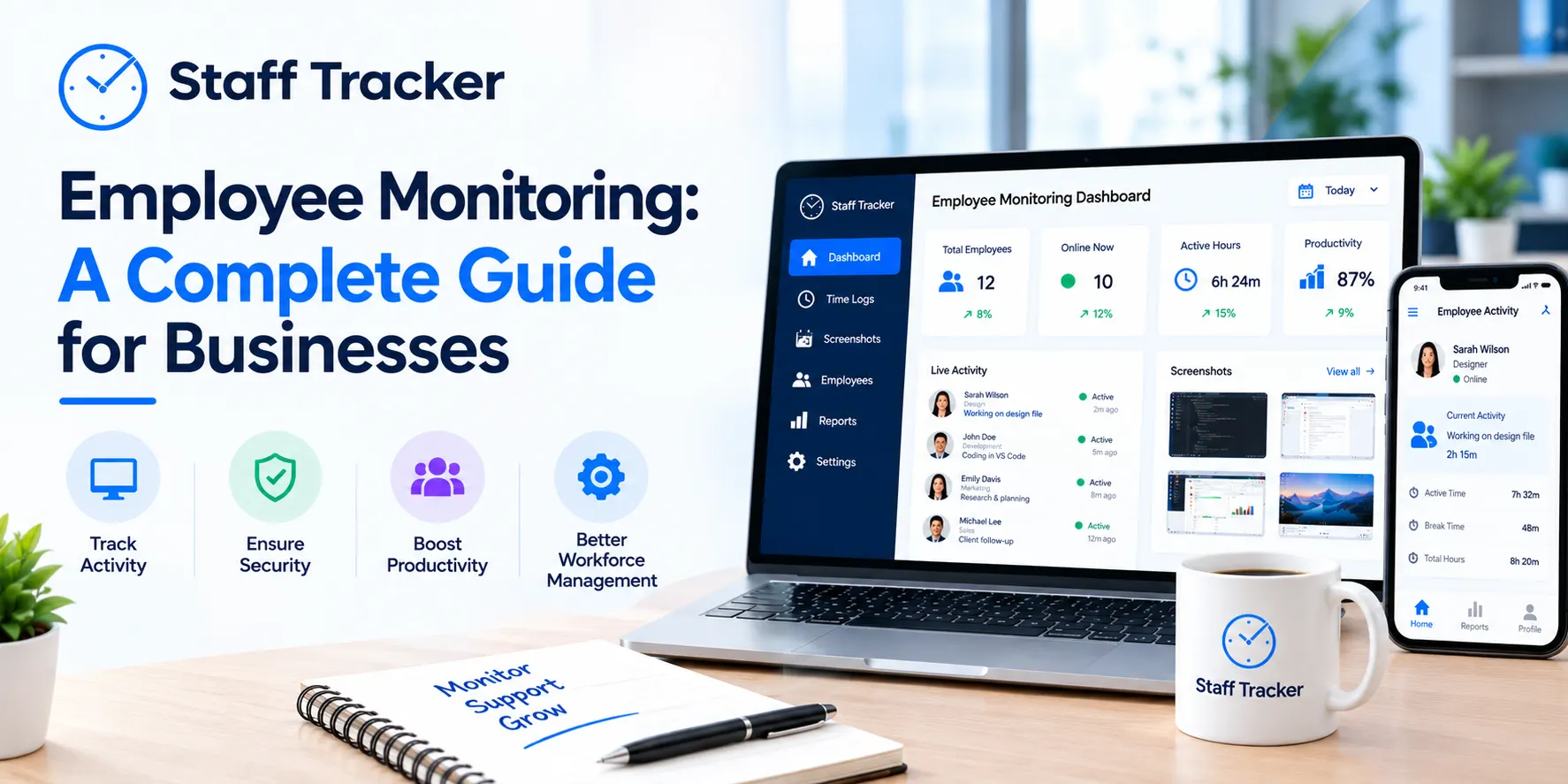
StaffTracker, for example, helps companies manage employee workflow, track employee work time, and determine how work time is spent.
This guide explains how time trackers enhance productivity, create transparency, and enable better decisions for remote and in-house employees.
What Is a Time Tracker with Screenshots?
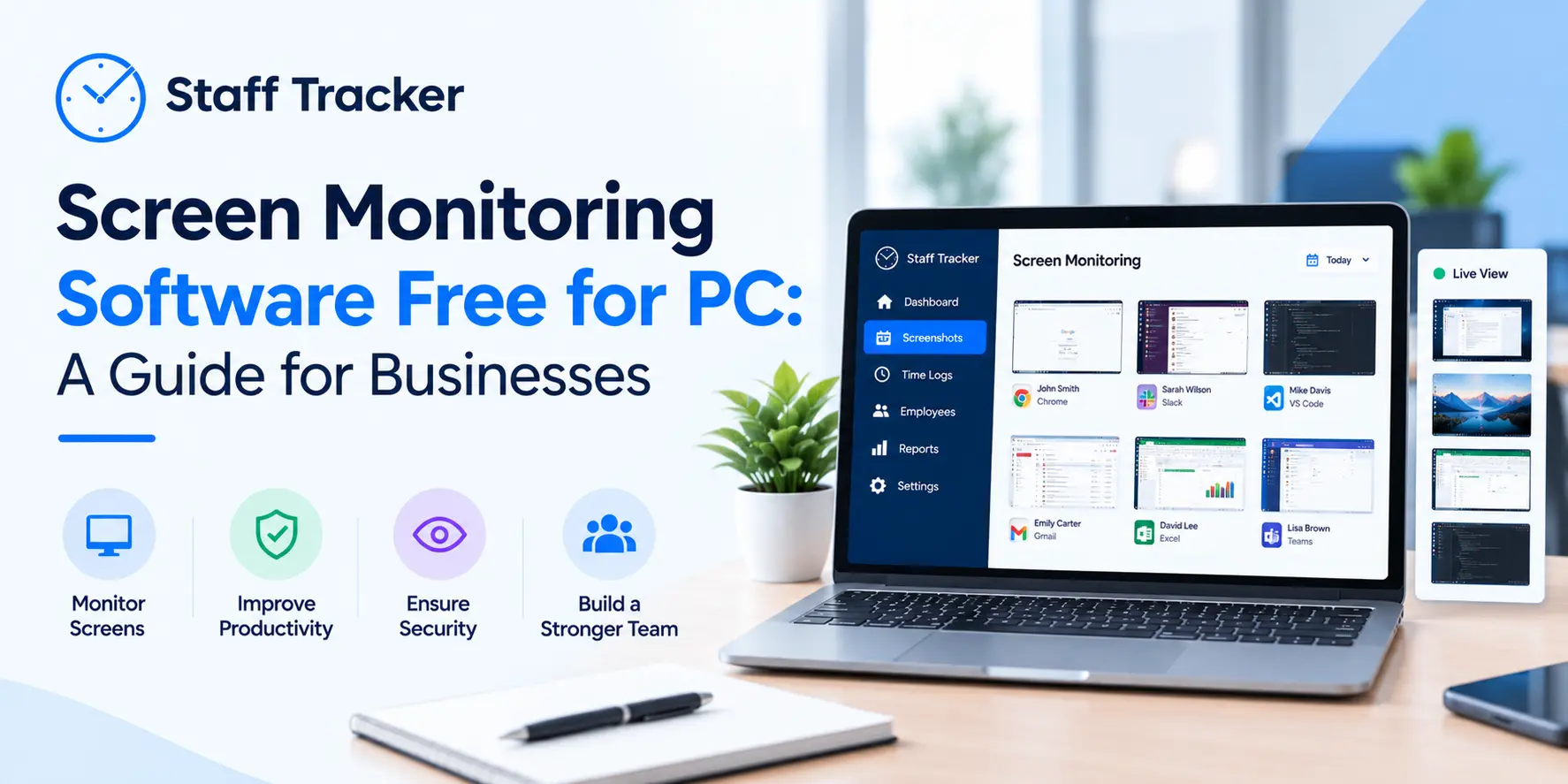
A time tracker with screenshots is a software program that records employees’ work time and takes screenshots of their work time. It does this at predetermined intervals.
The aims are clear:
Accountability for work to ensure time and resources are not wasted
Productive gaps to be treated with the best work proof
Full transparency of the work
Many organizations, as part of their time management, practice screenshot monitoring. Visual context ensures a better understanding of the workflow for managers. Rather than recording time, the team validates work progress by activity prompts. Tools of the industry like TMetric, TimeCamp and Desklog rely on screenshots to improve the visibility and accountability of remote work.
The increasing number of remote works means it is no longer possible for managers to observe work in a traditional manner. All enterprises need to make the necessary adjustments to maintain customer efficiency without the employee losing accountability for themselves.
A time tracker with screenshots solves this problem by offering real-time work insights.
The need for screenshot tracking is as follows:
Managing remote teams, Tracking billable hours, Ensuring project transparency, Time theft prevention, Analyzing productivity trends, Client reporting, Ensuring the accuracy of payroll.
Time and activity monitoring with screen captures fosters distinct accountability and allows managers to identify bottlenecks.
How a Time Tracker with Screenshots Boosts Productivity

1. Helps Employees Stay Focused
Workplace distraction is one of the greatest productivity issues of remote work.
Efficiency can be reduced through social media, unneeded meetings, and multitasking. Fair activity tracking improves mindfulness in time management.
Time tracking with screenshots establishes accountability and targets the greatest issues without requiring constant supervision.
This does not create a sense of pressure among employees. Rather, it has a positive impact on time management, as employees can understand the distribution of their hours and take full advantage of that to better their time management skills.
Discipline and intensity are the attributes developed when the time tracker with screenshots is used on a daily basis.
2. Time-wasting is Decreased
Loads of productive hours are lost in virtually every average business without their noticing it.
Employees can waste hours having a high frequency of task switching, delays in task completion, poor time estimation, and even time-taking non-business-task activities. Time tracker with screenshots helps managers to quickly identify the loss of business productivity.
These can take the forms of:
Frequent delays in workflow, Excess days of being idle, Longer delays caused by accessing unnecessary web pages, Lengthy repeated activities that could have been automated.
With the endless data derived from time tracker with screenshots, companies can dare to fine-tune their workflows instead of their employees, based on the loss of business productivity that the time tracker with screenshots have helped identify.
This is one of the reasons companies are choosing to use time tracker with screenshots and type of systems.
3. Enhances the Management of Remote Employees
Managing remote employees has always been difficult, but not at all with the time tracker.
The absence of a time tracker on business systems can make remote work confusing to managers about:
When the task is done, The total amount of hours worked, The availability of the whole team, The intended time to have the whole project done.
With the time tracker, managers have the benefit of real time work status updates without holding a single meeting.
With the time tracker, managers can view the:
Work that is in progress, Time spent doing the work, The form the work is taking.
This time tracker with snapshots type of business systems enhances reporting and improves work time utilization.
4. Increases Accountability
The most significant reason team members hold each other accountable is the time tracker with snapshots of business systems on a daily basis.
Both the employees and management have a clear and visible record of the work that has been done. This eliminates potential problems and helps build a reliable work system.
For instance:
Employees showcase billable work, Managers assess advancement in projects, Clients look at real time utilization, Disputes in payroll are easier to settle.
All can see the benefits of transparency.
An effectively structured Time Tracker with Screenshots provides employees with unfair assumptions while also shielding companies from loss and unwarranted claims.
5. Helps Identify Productivity Trends
Productivity is not just an economy with the clock.
It is an understanding of:
When employees perform at their level best, Which task takes up time the most, What impedes workflow
Screenshot enabled trackers to provide the visual data necessary for more informed and rational decision making.
For instance, a company can learn:
Meetings take up a large chunk of productive time.
Some tools impede employee progress.
Automation is needed for some tasks.
Better planning is necessary for certain projects.
The organization is able to make continuous progress.
The Key to Transparency

Transparency is one of the most important things in the workplace.
Employees want a system that is just. Managers want a system that accurately reports. Clients want the ability to see progress in projects.
A Time Tracker with Screenshots helps provide transparency at all levels of business.
Some Proof of Work
At certain times, it can be very difficult for freelancers and certain remote teams to show their work hours.
Screenshots provide the visual proof necessary of the work that was completed in the tracked hours that is built up.
Time tracked in that hour can be used for:
Billing to the client, Contracts for freelance work, Teams that are outsourced, Projects billed on an hourly basis.
Time tracking systems that depend on screenshot work are one of the best ways for clients to build confidence in a system.
The Improvement of Communication Between Teams
With transparency, communication is improved.
Since everybody has a clear view of the workflows, the number of misunderstandings has dropped.
Managers recognize what employees are working on, and employees recognize what managers are expecting.
This decreases:
Micromanagement, Frequent status meetings, Confusion, Feedback lag.
A transparent system cultivates a positive work culture to foster productivity without the need for constant status updates.
Aims for Just Performance Evaluations
Most performance evaluations are subjective and based on limited insight.
Using a Time Tracker with Screenshots, managers can assess work with concrete evidence to give informed feedback.
This ensures that organizations:
Recognize high achievers, Determine skill gaps, Reallocate tasks, Mitigate employee fatigue, Evaluations based on data reduce bias.
Monitoring Screenshots Correctly
Organizations need to remember: Surveillance can’t be overbearing.
A Time Tracker with Screenshots should be a way to optimize productivity, not a source of dread.
A positive example of the right kind of monitoring is:
Informing employees, Creating clear policies, Limiting how often screenshots are taken, Monitoring with the purpose of maximizing productivity rather than collecting data.
There has been a surge in monitoring systems that use privacy-preserving tools such as blurred screenshots, optional logging, and employee settings for visibility.
Creating a trustworthy environment is more important than the data collected.
When employees are shown the underlying goals of monitoring, they are more open to accepting it.
The Correct Time Tracking System with Screenshots
The quality of tracking systems is not uniform.
When searching for a system, companies should evaluate:
Time tracking automation, Clever screenshot logging, Productivity analytics, Integrated project tools, Idle time recording, Data protection, User-friendly interfaces, Privacy settings, Support for remote work.
With StaffTracker, companies can implement a time tracking system to record activity without losing transparency and accountability with hybrid and remote teams.
Final Insights
Tools like a Time Tracker with Screenshots are now invaluable to the productivity infrastructure of modern organizations, not just employee monitoring.
Utilized properly, the tools can help companies to:
Increase focus, Decrease time wastage, Create transparency, Boost accountability, Manage remote teams with greater efficacy, Make more informed decisions.
The important proposition is balance.
Monitoring ethically and communicating transparently fosters employee trust, and in the long run, will always yield better results, as opposed to relying solely on monitoring.
In the changing work environment, which is heavily reliant on remote work, transparency and productivity are not mutually exclusive. A Time Tracker with Screenshots is effectively a tool that helps organizations enhance both transparency and productivity seamlessly.
Frequently Asked Questions
1. What is a Time Tracker with Screenshots?
It is a tool that assists organizations in tracking their employees’ time and enhancing productivity by capturing periodic screenshots of employees’ work.
2. Does screenshot monitoring enhance productivity?
Definitely. Employees become more accountable and less distracted, and time management improves screenshot monitoring.
3. Is screenshot monitoring permissible?
Screenshot monitoring is permissible in most jurisdictions if employees are appropriately informed, and local privacy and employment laws are adhered to.
4. Does screenshot monitoring help build trust?
Yes, bringing transparency into monitoring practices and streamlining accountability helps to build trust by lessening the communication gap.
5. Why are Time Tracker with Screenshots tools useful for remote teams?
These tools are useful for remote teams to help them track billable time, assess the visibility of progress, and foster productivity while dealing with distributed teams.
6. What features should businesses look for in screenshot tracking software?
Based on the software, businesses should look for:
Automatic time tracking, Screenshot capture, Productivity reports, Privacy controls, Project integrations, Secure data storage, Remote workforce management tools.
Content written by Saurabh Sharma
Saurabh is part of the expert content marketing team at ZoomIntoWeb. He has expertise in curating meaningful information that can be used by visitors in general. Saurabh is also involved in creating client-specific stories and blogs.
 09-10-2026