
- By Admin
- 25 Nov, 2025
- 386 Reading
The use of time tracking has become one of the indispensable tools of small businesses around the world without much noise. With the transformation of companies to hybrid, the use of digital cooperation, flexible working hours, and remote working forces, the knowledge of how employees use their working hours is no longer a choice, but a strategic necessity. Particularly, small businesses work with limited resources, smaller teams, and smaller margins. This is because each minute of productivity is counted. This is the reason why the future of employee hour tracking is evolving fast due to the emerging technology, the rise of insight and the advanced system aimed at making the operations of a day simpler.
The small businesses are now relying more on a time tracking software for small businesses in order to inject transparency, accountability, and performance-related clarity in their small firms. However, time tracking is also continuing to change as the workplace changes. The devices that used to record the mere working hours are now changing to smart systems that have the ability to analyze productivity, detect inefficiencies, track work processes and even predict performance trends. Knowing the direction this technology is taking can provide the small businesses the insight to plan on the future- and be ahead of others.
Automation Will Shape the Next Era of Time Tracking
The striking trend in the field of workforce management is automation. Small businesses do not have time to look at attendance registers manually, verify time sheets or line by line audit employee productivity. Time tracking is automated and eliminates the chances of a human factor and also ensures that the employee hours are recorded correctly without the need to monitor the employee all the time.
Time tracking software for small businesses can record the active time, idle time, logins, breaks, and overall performance without any type of manual entry by the employees. This does not only enhance accuracy, but also saves unnecessary administration to the managers. Automation will extend further in being more intelligent, utilizing smart triggers that can identify patterns in behavior, task interaction and workflow interruptions. The resulting evolution will enable businesses to run more effectively and less friction as it is usually associated with manual reporting.
Automation also assists in the establishment of equity. In a situation where time logs are automatically recorded, employees also feel assured that their work is well documented. This openness enhances trust and advancement of the overall working environment which is particularly crucial in small teams where relationship and cooperation is of importance.
Screenshots and Activity Verification Become Standard Practice
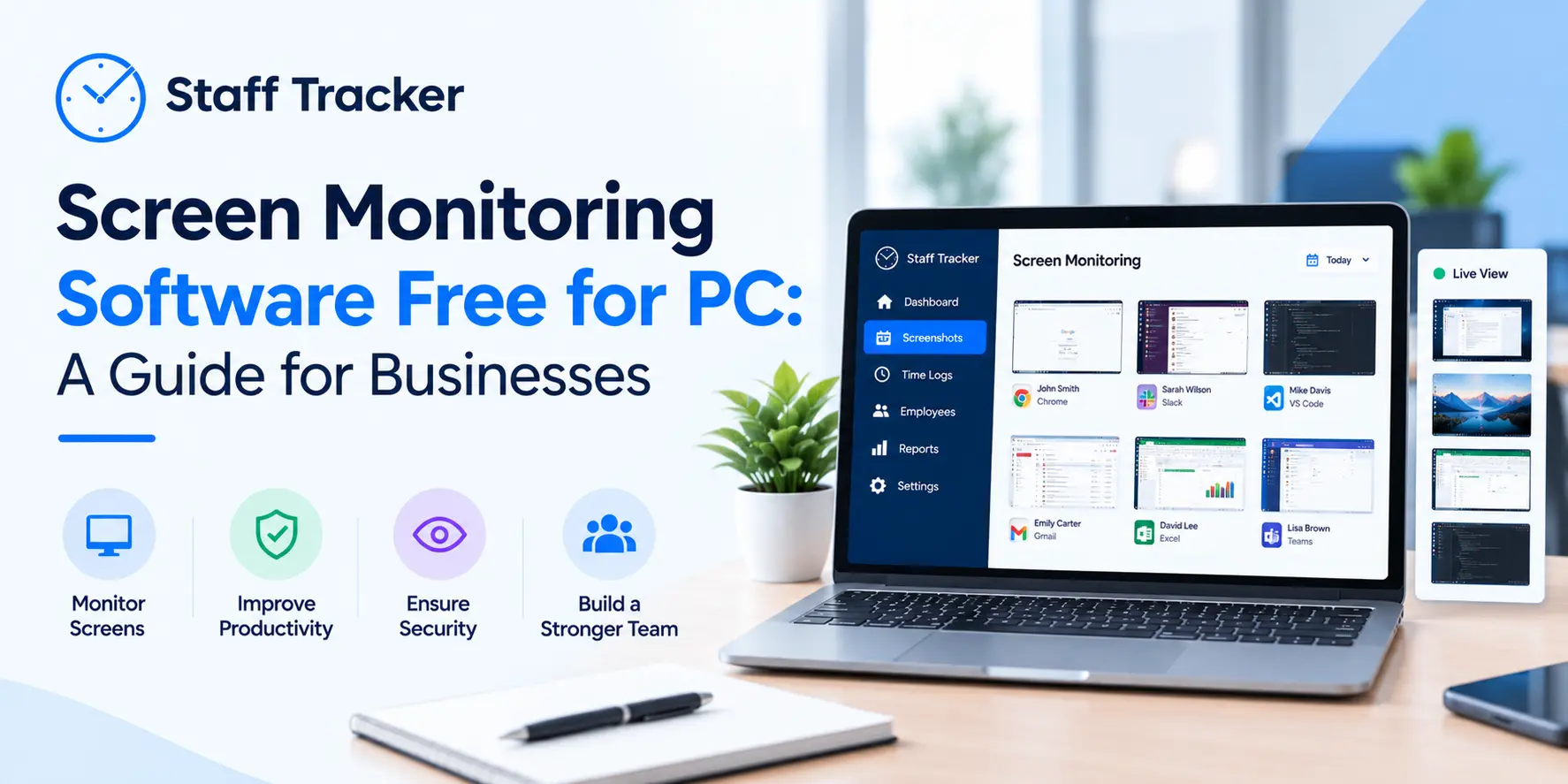
Among the most obvious trends in time tracking, one can distinguish the introduction of the option of screenshots and activity verification. Although this might be technical, it is literally one of the easiest methods that small businesses should use to guarantee a real engagement in work. Screenshots are visual evidence of work and allow managers to know how employees use their time without interfering with them by constantly checking their work.
A time tracking software for small businesses that allows capturing screenshots will provide them with the clarity, minimize the misunderstanding, and allow managers to support their teams with real data. This can particularly be of value to remote employees, freelancers, people working in the field and those whose work cannot be physically supervised. Screenshots will even be smarter in the years ahead, not only taking an image of the screen, but even analyzing task relevance. This will assist the businesses to know the dynamics of the work patterns and how productivity could be enhanced.
Also screenshots will be significant with regard to training and quality control. Small businesses will have an opportunity to learn how tasks are carried out at particular times and what best practices are and develop training materials that are based on the real world performance situations. The managers will no longer need to make guesses as they can have clear visual evidence based on which they will be able to give much more accurate feedback.
AI and Predictive Insights Transform Productivity Tracking
Amazon Artificial intelligence is gradually finding its place in the business toolset and the time tracker is not left behind. Instead of just writing down the amount of hours, AI-powered time tracking solutions will assist owners in realizing which working processes are effective, which activities waste time, where bottlenecks are located, and which employees might need assistance. It is also possible to predict the patterns of workloads with the help of AI, see the low productivity periods and suggest the methods of performance optimization.
An AI-powered time tracking software for small businesses will assist managers to make better decisions. AI will not only focus on hours, but will also emphasize more profound trends, including the impact of distractions on output, the frequency with which employees move between applications, or the most productive times of the day. These can be utilized by small businesses to restructure schedules, distribute tasks more efficiently and affordably handle workload allocation.
As well, AI-based forecasting will assist in preparing companies for future projects. Through historical data analysis, the software will be able to determine the time required to perform a certain task, the number of individuals required, as well as identify areas where delays are likely to arise. Such planning used to be the prerogative of large institutions but it is not long before it will be brought down to the level of small groups.
Mobile Tracking Will Become More Essential
Mobile time tracking is now essential with the increase in remote and field based employment. Small companies have to be dependent on the teams operating outside office setting delivery staff, field executives, service technicians and construction crews, salespeople and on-ground supervisors. Mobile tracking is not only handy but also essential to such teams.
The new generation of the time tracking software for small businesses will also involve integrating the mobile application features to track time, attendance, distance covered, geo-locations, call logs, and instant movement. This will enable the business to follow scattered teams and make sure working hours are in harmony with the field activity. Mobile time tracking will also enhance accountability as it will check the work on site and avoid any distortion that arises when teams are manually reporting their time hours.
With the expansion of small businesses, mobile systems will be more closely connected with desktop systems, and workflow will be unified. Combination of this will mean that office-based and field-based employees will be monitored in a dependable and uniform way.
Workforce Transparency Will Become a Cultural Expectation
The current generation of workers is appreciative of lucidity and justice. The employees like systems that indicate clearly to them how they are appraised and how their contributions are measured. A time tracking software for small businesses assists in establishing such transparency with the help of precise data of hours worked, tasks to be done, and productivity levels.
Time tracking will stop being something about monitoring and start being empowering in the future. Employees will access data to learn their work patterns, better time management, and establish their productivity targets. By providing the time data publicly, one will remove confusion, misunderstanding, and establish stronger connections among the employees and management.
Accountability also is enhanced by transparency. Having clear work patterns, the employees become more responsible about their time, and the managers become more visible. This mutual understanding leads to a culture of performance being data-oriented and not reliant on assumptions and personal impressions.
Cloud-Based Tracking Ensures Flexibility and Security
Due to the rapidly growing number of small businesses based in various places, freelancers, and remote workers, time management in the cloud will be very necessary. Local software or manual systems are no longer able to meet the modern operational requirements. With cloud platforms, information will always be accessible, backed up, and (most importantly) stored in professional servers that are secure.
This can be a time tracking software for small businesses based on cloud technology that enables managers to see the reports at any time of the day, in any given device to enable real-time visibility. Data in cloud systems is also secured by means of encryption, access controls and secure storage. This will minimize the chance of loss, manipulation, or loss of data.
The future cloud-based systems will be built with much better security, instant syncing, automatic back-ups and cross devices. This will ensure that time tracking is smooth and dependable especially in small businesses who cannot afford technical downtimes or information risks.
The Bottom Line
Time tracking in the future is far beyond the process of documenting work hours. It is also about the establishment of a workplace that will flourish on transparency and responsibility and well-informed decision-making. The current environment of small businesses requires that time, resources, and productivity should be optimized to the dot. This could be done using a time tracking software for small businesses which provides real-time insights, intelligent reporting, advanced monitoring tools, and systematic workforce management.
With the changing technology, time tracking will not be a mere tool in the operations of an organisation, but become a strategy. Small businesses will redefine the measurement and understanding of productivity using automation, AI-driven analysis, mobile tracking, cloud systems, screenshot-based verification. The innovations will enable teams to be stronger, trust in each other, and build businesses with confidence.
The future time tracking is smart, ethical, transparent and highly aligned with the needs of contemporary small businesses. Early adopters of these trends will get a competitive edge- developing effective teams, smooth operations, and improved basis of success in the long term.
 07-10-2026