
- By Admin
- 07 Oct, 2026
- 38 Reading
How can you tell whether your employees are productive? Are you basing your assessments on hours worked, completed tasks, or even results?
You may be surprised to learn that a single factor rarely contributes to productivity.
An employee may spend eight hours working on the computer but waste significant time on non-work-related Internet sites and activities. Similarly, a productive employee can achieve great results within a short amount of time thanks to the right tools and efficient work processes.
Employee productivity monitoring makes it easier for businesses to evaluate patterns, identify potential issues, and optimize operations.
When used correctly, employee productivity monitoring can highlight inefficiencies and help teams focus on actual work instead of encouraging micromanagement.
This guide discusses employee productivity monitoring, including its benefits, vital metrics, and how to get the most out of monitoring software.
What Is Employee Productivity Monitoring?
Employee productivity monitoring refers to analyzing work-related activities, time logs, and other factors to identify patterns and operations.
Depending on the software and the rules a business sets, employee productivity monitoring typically logs:
Working hours and time records
Attendances
Application and website use
Computer idle time
Completed tasks and project progress
Screen snapshots or similar information, where applicable
For instance, if a team fails to meet crucial deadlines, a manager may analyze project management tools and computer activities to spot inconsistencies and address the issue.
Similarly, employee productivity monitoring can help businesses understand the key factors affecting their ability to achieve project goals and objectives.
What’s the Point of Employee Productivity Monitoring?
Modern businesses want to maximize the value they get from every employee.
Monitoring and analyzing relevant data make it easier to evaluate productivity, identify opportunities for improvement, and optimize operations.
Moreover, employee productivity monitoring can:
Enable more efficient time management.
Improve processes
Hold workers accountable by setting performance expectations and reviewing time records, completed tasks, and other factors.
Make project tracking and management easier, especially for remote teams.
Help managers make better decisions by providing statistical data and performance insights.
However, it is worth noting that businesses may collect plenty of information without knowing how to analyze it and what to do with the results.
In other words, employee productivity monitoring only makes sense when the right tools are used, and the data is interpreted correctly.
How to Monitor Employee Productivity?
The whole point of employee productivity monitoring is to establish a baseline for efficient operations and spot concerns. With that in mind, businesses should set specific goals for this process since generic insights rarely make much sense.
Set Specific Goals
Productivity monitoring goals should be based on expected results and the information a business wants to collect. For instance, businesses can base these goals on the following factors:
Achieved goals, objectives, and deliverables
Applicable deadlines
The general quality of work
Customer satisfaction and other relevant metrics
With that in mind, businesses should identify the factors they want to improve. In other words, the aim of this exercise should be to optimize processes instead of collecting random bits of information.
Collect Relevant Information
This step is self-explanatory since businesses should use relevant tools to collect the necessary data.
For instance, a manager reviewing missed deadlines may want to analyze time logs, project management tools, and the general progress of relevant projects.
On the other hand, businesses can track computer activities to get insights into how employees spend their working hours.
Analyze Collected Data
At this point, businesses should focus on identifying trends and factors that require optimization, and it is worth noting that a few days or weeks of data may be needed for this step.
In other words, a sudden spike or drop in employee productivity is not necessarily worth immediate action. Instead, businesses should always consider bigger pictures.
Take Action
The final step is to optimize relevant processes and make the necessary adjustments. Businesses should always keep their options open at this point since one size does not always fit all.
Five Most Important Employee Productivity Metrics (That Actually Matter)
Businesses can use various metrics to identify key trends affecting employee productivity in a given organization.
Most of these factors concern employees’ tasks and responsibilities.
The following five points can serve as a starting point for any business interested in improving employee productivity.
Employee Productivity Metric | Description |
Task completion | Whether scheduled tasks and responsibilities are completed |
Time required to complete tasks | Where time is spent in relation to specific tasks and responsibilities |
Attendance and working hours | Whether attendance and working hours are up to standard |
Work quality and error rates: | Whether the delivered work is of acceptable quality. |
Computer application usage | How computer applications relevant to work are used regularly |
1. Task Completion
This metric is self-explanatory since it reflects whether scheduled tasks and responsibilities are completed in a timely manner.
The data collected can be used to spot inefficiencies and optimize workloads.
For instance, if a project team regularly fails to meet established deadlines, the manager may need to rethink the distribution of responsibilities among team members.
2. Time Required to Complete Tasks
These metrics highlight time spent versus time required to complete specific tasks.
As mentioned, businesses should always take a realistic approach and examine various causes and contributing factors.
For instance, a sudden increase in the time required to complete a specific set of responsibilities may be the result of a spike in workload, technical difficulties, or additional quality control steps.
3. Attendance and Working Hours
Attendance records and schedules highlight hours worked, which can be important for payroll purposes.
At the same time, this metric can be a vital tool for identifying issues since businesses can compare working hours with completed tasks and responsibilities.
In other words, organizations should recognize that working hours are only part of the equation. Employees who show up at the office or online workstation regularly do not necessarily work at the same level.
4. Work Quality and Error Rates
This factor reflects whether the delivered work is of acceptable quality.
As mentioned, employee productivity monitoring is not just about completing more tasks and responsibilities. Businesses should also examine whether completed tasks and responsibilities are up to standard.
5. Computer Application Usage
Application usage reports reflect how relevant computer applications are used within a specific time frame.
These reports can be vital tools for optimizing productivity.
For instance, businesses can examine the causes of identified trends and optimize relevant processes. However, it is important to remember that more does not always mean better, and computer activity analysis should always be part of a larger initiative.
Employee Productivity Monitoring Software – What Does It Offer?

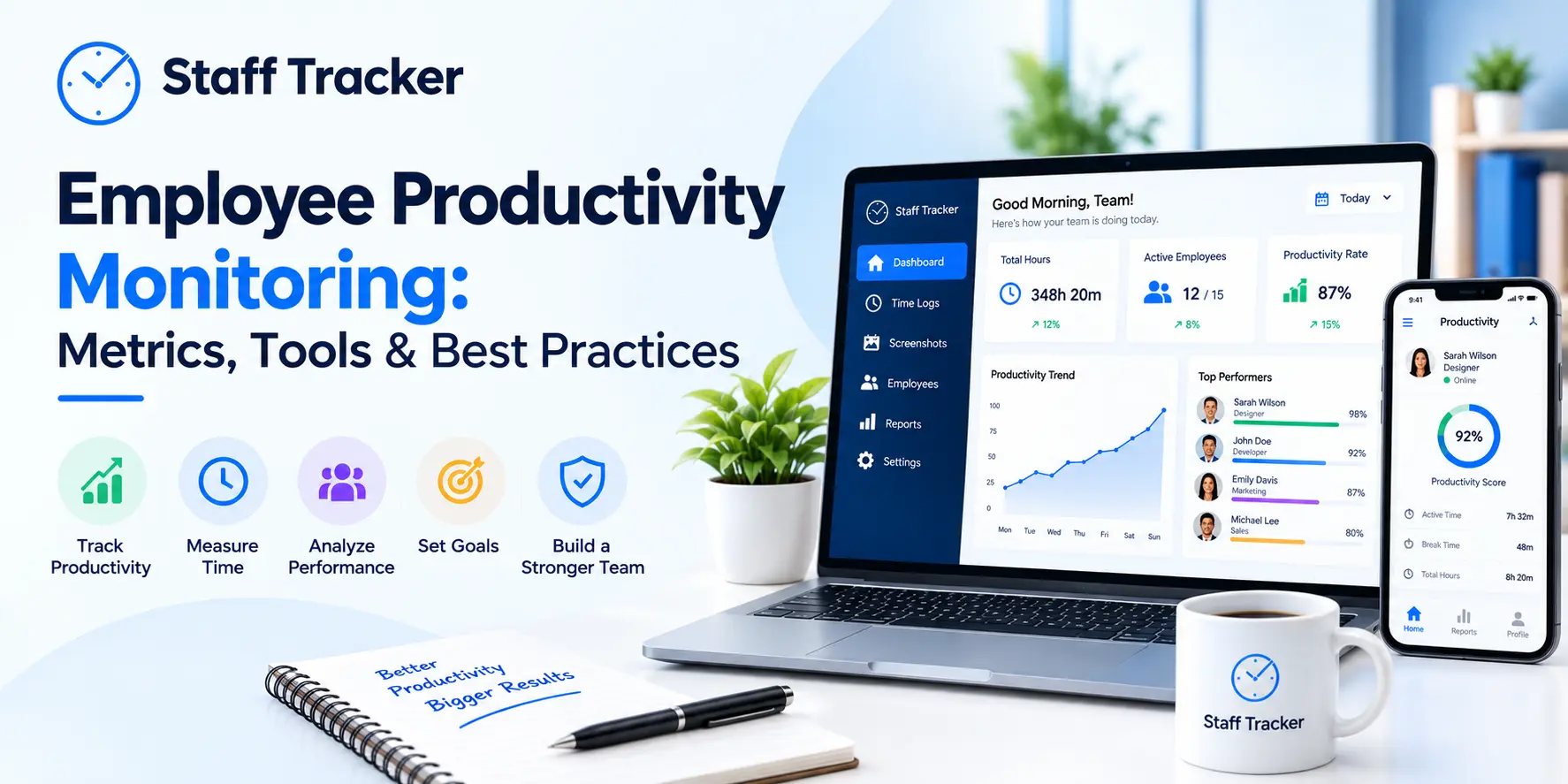
Employee productivity monitoring software can help businesses collect and organize the data they need to optimize processes.
Depending on a business’s needs, the software can offer the following features:
Activity monitoring to spot trends and patterns concerning website visits and computer application use
Time tracking features to examine working hours and time spent on specific tasks
Attendance features that highlight scheduled work hours and current attendances
Reports regarding computer idle time, which can be useful in some cases
Reports, screenshots, and other relevant features for authorized users, if applicable
With that in mind, businesses should always think about their options. Employee productivity monitoring is not a one-size-fits-all affair, and the software should highlight a wide range of factors that may affect an employee’s productivity.
When comparing different products, businesses should consider the following:
Essential features
Report quality
Time tracking tools
Applicability and ease of use
Data privacy and other relevant security concerns
Scalability and overall value
In other words, there is no point in selecting a product based on a long list of irrelevant features just because it has more options. Instead, businesses should examine existing tools and choose the ones that offer the features they need.
Businesses considering employee activity monitoring, time tracking, and attendance should request a free demo to see whether Staff-Tracker is a good fit for them.
How to Monitor Employee Productivity – Without Micromanaging?
Employee productivity monitoring is not an excuse for micromanaging employees.
The information collected should help businesses find ways to optimize processes.
Below are a few suggestions that may help a business achieve this goal.
1. Focus on Results and Outcomes
Businesses should always set clear expectations and use project management tools and computer activity monitoring solutions.
However, when analyzing this data, it is important to focus on results and outcomes instead of individual activities.
2. Be Honest and Straightforward About Monitoring
Transparency is essential, which means businesses should always set out their requirements and ensure that employees understand the purpose of this initiative.
3. Identify Trends and Patterns
As mentioned, a few days or weeks of data may be needed to spot meaningful trends.
4. Address Concerns and Find the Root Cause of Issues
Businesses should always analyze identified concerns and work with employees to find the root cause of these problems.
5. Focus on Optimization and Process Improvement
If the analysis of trends and patterns highlights recurring issues, businesses should identify the causes and optimize relevant processes.
6. Ensure Employee Privacy Is Respected
Respecting employee privacy is essential, which means businesses should only collect the data they need and store it securely. Moreover, access to this data should be restricted to authorized personnel.
Summary
Employee productivity monitoring can help businesses identify crucial trends and optimize processes.
The goal of this process is to improve operations rather than measure each hour an employee spends at a workstation.
This guide discussed the primary benefits of employee productivity monitoring, the most important metrics, and the features of monitoring software.
Ultimately, businesses should only track relevant data to get meaningful insights that will optimize time management and improve productivity. Additionally, the collection of this information should follow local privacy laws and regulations to avoid potential legal concerns.
Practical Example
Let us imagine a customer support team that has difficulty completing the required number of tickets. Usually, a team leader assumes that employees need to work faster.
However, an analysis of completed tickets and computer activities highlights that they tend to use several applications to find the necessary information.
Instead of trying to make employees more productive, the business can streamline this process and reduce the time spent searching for the required data.
The team can then review ticket resolution time and error rates to check whether these optimizations have helped.
In other words, employee productivity monitoring is only useful if it can highlight areas of improvement.
Moreover, it is essential to analyze the underlying causes of trends and patterns.
Is Employee Productivity Monitoring Legal?
Employee monitoring laws can vary depending on the countries and jurisdictions a business operates in, the employees’ working conditions, and other factors.
Ideally, businesses should consult a lawyer to understand the legal requirements and ensure that employee productivity monitoring follows applicable data privacy laws and regulations.
For this guide, we will assume that the basic legal requirements include:
Establishing a valid reason for monitoring employee activities
Making sure that employees are aware of these reasons and that monitoring software requirements are explained in sufficient detail
Limiting the data collected to the information relevant to the initiative
Restricting access to this data and ensuring that it is stored securely
Having clearly defined retention policies
Seeking legal advice when the requirements are not clear
Summary
This FAQ highlights the most common questions regarding employee productivity monitoring.
What is the purpose of employee productivity monitoring?
The primary purpose of employee productivity monitoring is to analyze work activities and related factors to identify patterns and optimize processes.
How can you measure employee productivity?
Measuring employee productivity typically involves a combination of factors, including completed tasks, work quality, and time records.
Can employee productivity monitoring benefit remote teams?
Yes, since it can help businesses track working hours and relevant activities. Additionally, remote teams need to understand how their work contributes to the bigger picture.
Does employee productivity monitoring software improve performance?
Yes, since it can help businesses identify opportunities for optimization. However, it is always a matter of interpreting the results correctly and making the necessary adjustments.
What is the difference between employee monitoring and productivity monitoring?
The term “employee monitoring” is a generic term that can cover a wide range of activities and tools.
In contrast, employee productivity monitoring refers to a process that focuses on work activities and aims to optimize relevant processes.
Written by the Staff Tracker Team
This content was authored by the Staff Tracker team, which has lots of experience managing the workforce as well as tracking time and attendance and employing HR Technology. Staff Tracker creates content that is practical and speaks to the pain businesses have with optimizing workforce operations and improving productivity in the business.
 07-10-2026